
Veefin 4.0
Transaction banking, lending and financing infrastructure run on the same foundation — shared services, a single data layer, one security model, one integration framework — so adding the next product extends the platform instead of creating another silo. That is what makes running multiple Veefin products different from running multiple vendors.

The shared core: one customer record, one limit framework, one exposure view, one workflow and rules engine.

Masters, fees, entitlements, notifications, reporting — built once, inherited by every product.

Low-code integration and orchestration into core, rails, SWIFT, ERP and the wider ecosystem.

The conversational intelligence and action layer across every product.

ISO 27001 and SOC 2; cloud, on-premise or hybrid.
No bank sets out to build fragmented technology. It accumulates. A trade platform chosen a decade ago. A lending system added later. A separate collections platform, a digital-onboarding stack, a cash-management system. Each solved a real problem. Together, they become the estate the bank is left to operate.
And that estate has a standing cost. Every system is a separate contract, a separate integration, a separate upgrade cycle and a separate security review. The same customer exists across all of them — with different records, different limits and a different exposure view in each, forcing the bank to reconcile what should already be shared. A single change — a new approval rule, a new regulatory requirement — becomes a project repeated in every system. Change moves at the pace of the slowest vendor.


Banks don't solve fragmentation by adding more integrations. They solve it by reducing the number of systems that need to be integrated in the first place.
When transaction banking, lending and financing infrastructure share one architecture, the costs of fragmentation aren't managed down — they're never incurred. Products extend the same foundation instead of bolting onto it. Data is shared, not reconciled. A change is made once and inherited everywhere. Security and governance are defined once, for everything.
The result is a bank that sees customers, limits and exposures consistently across every product, instead of reconciling them across multiple systems.
The rest of this page is how the architecture delivers that.
The real choice a bank makes isn't product by product. It's architectural — and it shows up across technology, operations and governance, not just the IT estate.
The fragmented estate isn't just more technology. It's more contracts, more integrations, more upgrades, more reviews and more reconciliation — every year, for as long as the bank runs it.
One architecture doesn't eliminate complexity. It eliminates duplicated complexity.

Everything in the previous section came down to a single structural decision: the products share a core, rather than each carrying its own. Veefin 4.0 is that core — the chassis §3 and §4 argued for.
The products a bank buys don't sit side by side on the platform. They sit on top of a shared core and draw from it.
At the foundation is Veefin 4.0 itself. On it sits one shared platform layer — common services, one security and governance model, and one integration framework — built once and inherited by everything above. Each has its own section later on this page; here, what matters is that it exists once, not once per product.
Above the plumbing is the layer that makes this one architecture rather than a well-organised collection of systems: a shared data and state layer. One customer record. One limit framework. One exposure view. One workflow A single data layer one customer, limit and exposure record across every product. The next section follows one corporate through it. A common workflow and rules engine approvals, processes and rules defined once and applied across every product. Section 9 shows what that's worth the moment something changes. and rules framework. Not a copy per product, reconciled overnight — a single record that every business reads from and writes to.
The businesses — transaction banking, lending, financing infrastructure — run on that shared core. Adding the next one doesn't add another customer model, another set of limits or another integration. It draws on what is already there.
That is the whole difference, stated plainly. Across many vendors, the products share nothing: each holds its own data, its own rules, its own connections, and the bank pays to reconcile them. On Veefin 4.0 they share the core — the data once, the rules once, the connections once.
Two of those claims carry the rest of this page, and the sections that follow prove them rather than assert them:

One customer, limit and exposure record across every product. The next section follows one corporate through it.

Approvals, processes and rules defined once and applied across every product. Section 9 shows what that's worth the moment something changes.
The single data layer is easiest to understand through one customer. Consider a mid-sized manufacturing corporate the bank wants to serve across more than one business.
Onboarded once. The corporate is brought onto the platform a single time. Its legal entity and ownership, its KYC and KYB documents, its financials, its credit assessment and risk rating, its approval hierarchy and its limit framework are all established once, and held in one place.

The corporate opens operating accounts and manages liquidity. The same entity, the same entitlements, the same approvers — nothing rekeyed.

The bank issues a letter of credit. It draws on the limit framework already in place, and the trade exposure lands in the same exposure view — added to the customer's total, not tracked in a separate ledger.

The corporate becomes an anchor, and the bank finances its suppliers. The program runs against the same anchor record and the same exposure, so what the bank has at risk to the customer — directly and through its supply chain — is one number, not several.

The corporate takes a working-capital facility. The credit assessment reuses the documents, statements and rating already on file; the facility draws on the same overall limit, rather than a new one set in isolation.
These aren't four accounts that happen to share a name. They are one corporate banking relationship — one customer, served by several businesses.
Credit intelligence, screening and risk assessment run once, on that single record, and every business inherits the same view. Change the rating, and it changes everywhere, because there is only one rating to change.

At any moment, the bank sees a single exposure view across every relationship it has with the customer — trade, supply chain, lending and transaction banking. Not four different answers from four systems, reconciled overnight to decide which is right.
The shared record is one layer of the platform. Beneath it sit the services every banking product needs but shouldn't have to build for itself — identity and access, entitlements, approvals, audit and reporting.
In a fragmented estate, every system carries its own version of each: its own logins, its own entitlement model, its own approval rules, its own audit log. On Veefin 4.0 they are platform services, provided once and inherited by every product. A new product doesn't arrive with its own control stack to configure and reconcile — it arrives already wired into the bank's, with the same users, the same permissions, the same approval rules and the same audit trail.
The consequence: every Veefin product is governed the same way from the day it goes live. One entitlement model across every product, one approval framework, one audit trail — not a separate set to stand up and reconcile for each product the bank adds.
Beyond identity and control, the same principle governs the platform's process infrastructure. The same workflow engine, onboarding and rules infrastructure can originate a loan, open a deposit account, onboard a corporate or launch a transaction-banking service — because the architecture is built around the customer, not the product. Most banking technology vendors live on one side of the balance sheet: lending on assets, treasury on liabilities, channels on engagement. Veefin is built to span all three, on a single customer record.


No serious banking platform runs without touching the systems a bank already has. It has to connect to the core, to payment infrastructure, to bureaus, to ERPs, to host-to-host channels and to the bank's own APIs. That work is real, and Veefin does it.
What a common architecture changes is how often it's done. The bank integrates Veefin to its estate once: those connections are established through one integration framework and then made available to every product on the platform. When the bank adds the next Veefin product, it doesn't re-integrate to the same core and the same payment infrastructure — it draws on the connections already in place.
This is integrate once, not never integrate. The estate still has to be connected; the difference is that the bank pays that cost for the platform, not again for each product on it. The slow part of adding a system — wiring it into the core and everything around it — is, for the second product and every one after, already done.
The consequence: integration effort is front-loaded and reused, not repeated. Adding a product becomes a matter of configuring it on connections that already exist, instead of rebuilding integrations the bank has built before.
Every CIO knows the pattern: you upgrade one system and another breaks, and a change that should be small becomes a project — because nothing is shared.
That single exposure view is only as good as the rules behind it — and rules change.
Suppose a regulator introduces a new exposure-classification requirement, with a six-month compliance deadline. It is one instruction, and the bank has to apply it everywhere that exposure is calculated.
In a fragmented estate, that one instruction becomes four projects. The trade system calculates exposure its own way and has to be changed. So does lending. So does supply chain finance. So does the reporting layer that rolls them up. Each is scoped, built and tested separately, on its own vendor's timeline — and until the last one is done, the bank's own systems disagree about the same number.


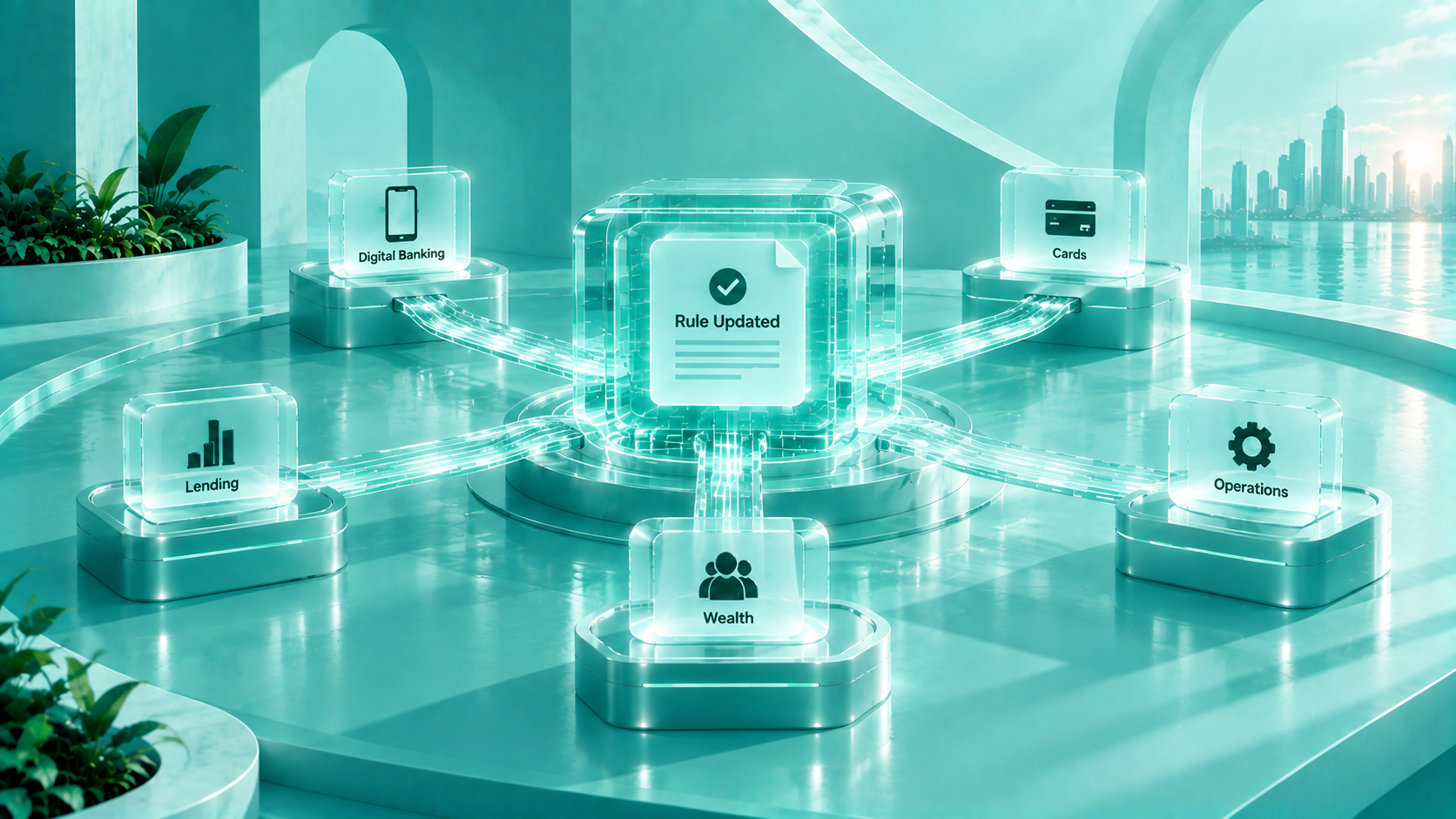
On Veefin 4.0, the rule lives in one place. The classification is defined once in the shared rules engine, the workflow around it changes once, and every product that calculates exposure inherits it. Defined once, inherited everywhere. And it is not only regulation — a new approval hierarchy, a revised risk policy or a new product program works the same way.
These are the two halves of what one architecture means: a bank holds one record of its customer, and it changes the rules over that record once — instead of making the same change again in every system that should already have agreed.
Intelligence on the platform isn't a separate product a bank buys and wires in. It runs inside the work the bank already does — verifying a document, flagging an exception, drafting a credit memo, reconciling an account, raising a risk alert — handling the routine so a person can decide what matters.
Because every product operates on the same customer, exposure and transaction data, intelligence is applied consistently across the platform. A risk alert raised in one workflow does not disappear in another. A document verified once does not need to be verified again. A credit assessment completed in one business can be reused by another.
The consequence: the same intelligence runs across every product, with no separate AI system to procure, integrate or govern. Nothing to bolt on, because it was never separate.

Security and governance are a property of the platform, not of each product. Access controls, auditability, data protection and compliance are defined once at the platform level and inherited across every product running on Veefin 4.0. The platform is certified to ISO 27001 and SOC 2.
So adding a product doesn't open a new security review, a new control set or a separate audit. The bank assesses and governs one platform, and every product on it inherits that posture.
The consequence: one security and compliance model to satisfy, certify and maintain — for everything, not for each product in turn.
Veefin 4.0 runs as SaaS, in the cloud, on-premise or in a hybrid of these.
A bank that chooses on-premise deployment receives the same platform, products and control framework as one running in the cloud. Deployment changes where Veefin runs, not what Veefin is.

Veefin 4.0 is not a concept architecture. It runs production systems used by financial institutions, national financing platforms and digital banks across Asia, Africa and the Middle East.

Veefin built and operates PSB Xchange, a national financing marketplace spanning supply chain finance, trade finance and the wider range of SME and corporate financing — opened beyond its founding consortium of public-sector banks to other banks and NBFCs nationally. It runs Kafalah, the national SME credit-guarantee program of Saudi Arabia, providing the web interface and the full guarantee stack behind it. These are not pilots. They are national infrastructure, in production.
Digital banks run several Veefin products together on one chassis — the multi-product architecture this page describes, operating in live banks rather than on a slide. Around them sits a growing roster of commercial banks, development institutions, digital banks and financial institutions across Asia, Africa and the Middle East running Veefin in production.

In the State Bank of India hackathon, Veefin's architecture carried a financing journey from document to credit decision to disbursement in a single connected flow, and took first place. It stands here not as a client relationship but as proof that the connective tissue between products holds: the end-to-end journey the architecture promises, demonstrated under scrutiny.
This architecture runs national platforms, it runs multiple products inside a single bank, and it runs the connected journey end to end.
Every section of this page has made one argument, in steps.
A fragmented estate carries a standing cost — paid every year in contracts, integrations, upgrades, governance and reconciliation. One architecture doesn't manage that cost down; it stops incurring it. The customer exists once. Limits and exposure are one view. Services, integrations and the security model are built once and inherited. A change is made once and followed everywhere. And this is not a diagram — the same architecture runs in production today, at national scale and inside live banks.
This is the difference between buying from Veefin and buying from many vendors. The question is not whether a bank will add more systems over time. The question is whether every new system increases complexity, or extends an existing foundation. With many vendors, every product a bank adds is another record to reconcile, another integration to build, another review to pass, another contract to manage.
So the choice the page opened with resolves: adding capability need not mean adding complexity. A bank can expand on one foundation, govern everything under one model, move faster because the architecture is already in place, and carry less fragmentation and lower cost for as long as it runs.
One customer profile. One exposure view. One governance model. One architecture beneath the systems a bank runs.