
Help corporates collect, pay, trade and finance through one bank. Veefin brings cash, trade, supply chain finance and corporate channels together on one platform — so banks deepen relationships, grow low-cost deposits and fee income, and become the customer's primary operating bank.

Payments, collections, liquidity and real-time visibility.

Letters of credit, guarantees, collections and trade financing.

Anchor-led programmes reaching suppliers and distributors.

The internet, mobile, API and host-to-host layer it all runs on.
A corporate's primary bank isn't the one that lent it money once. It's the bank embedded in how the company collects, pays, trades and operates every day — the bank whose rails the business runs on.
That embeddedness is what makes a relationship primary, and what makes it durable. Corporates rarely move their primary banking relationship because of a loan. They move because another bank becomes more deeply embedded in how they collect, pay, trade and operate.
The operating relationship sits at the centre of the wider banking relationship. The bank that receives the deposits, runs the payments, sees the cash flows and provides the credit becomes the customer's primary bank. Transaction banking is where that position is won — and why cash, lending and channels matter more together than they do separately.
So the work of transaction banking is not selling products. It is becoming, and staying, the operating bank at the centre of a corporate's day — the relationship that grows as the company grows, and that competitors find hard to dislodge.
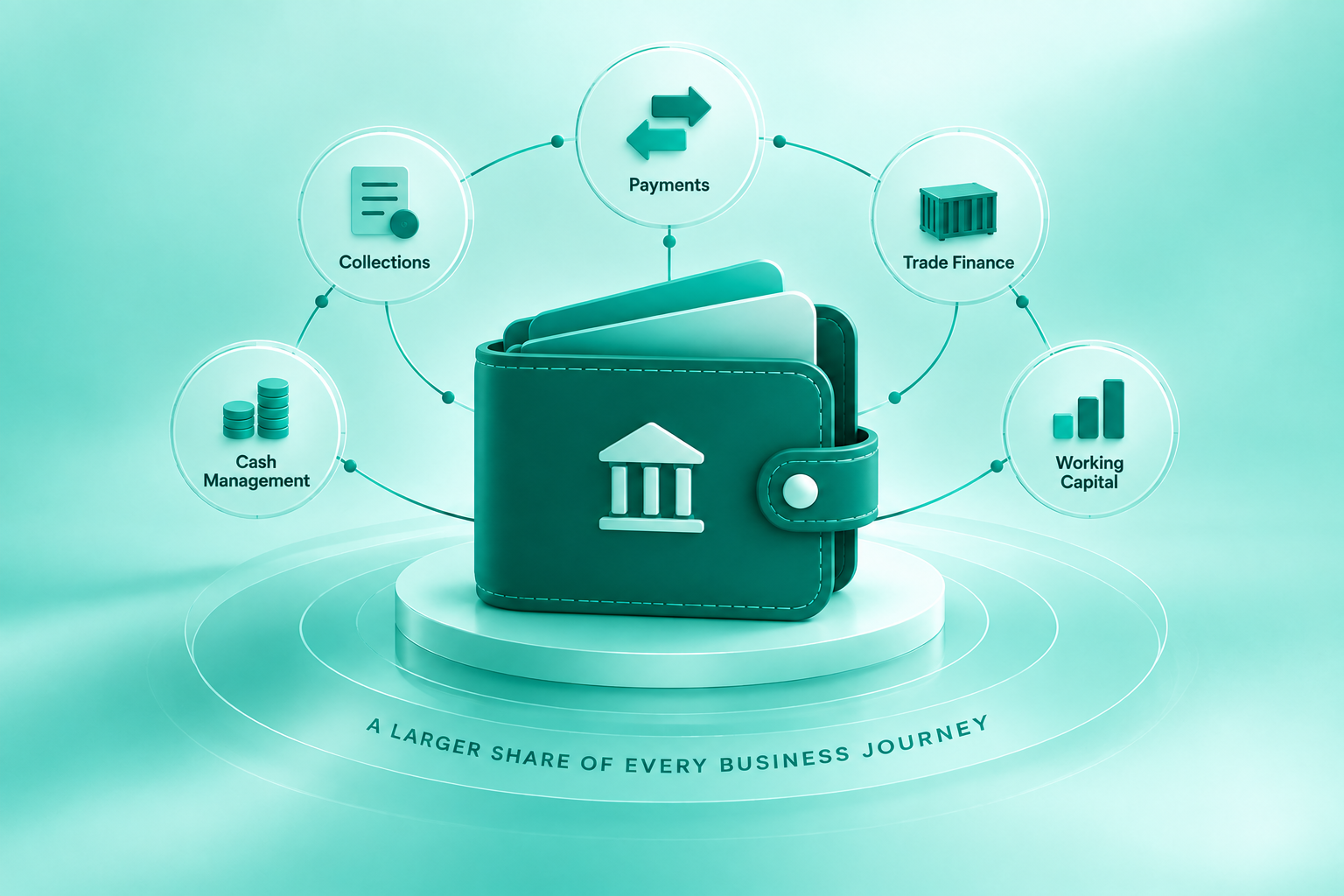
The strongest transaction banks don't run on products. They run on an engine: the more of a corporate's activity a bank handles, the more it learns, the more confidently it can finance — which earns it still more of the corporate's activity.
Activity → data → credit insight → financing → activity. Every turn deepens the relationship and widens what the bank earns from it.
It begins with operating activity. When a corporate collects, pays and manages liquidity through a bank, the bank captures the balances — lowcost deposits — and earns transaction and FX fees on the flow. It also gains something competitors don't have: a live view of how the business actually runs. That data is credit insight. It makes the bank the natural financier of the corporate's trade, and then of its supply chain — and supply chain finance carries the bank past the corporate to its suppliers and distributors, where the same engine starts turning again, on a wider base. More activity, more data, more financing, more reach — compounding.
Cash, trade and supply chain finance are how that engine shows up in the bank's products. Corporate channels are how it runs day to day — the portals, APIs and host-to-host connections through which the company banks, and the layer every turn of the engine depends on. And the more the engine turns, the harder the relationship is for a competitor to dislodge.
Veefin brings these capabilities together on one platform because they are most valuable when they operate as one system — one engine, compounding, rather than four products sold in isolation.

Cash, trade and supply chain finance are the turns of the engine; corporate channels are the layer they all run on. Here is what each does, and what it earns the bank.
This is where the relationship begins and where it lives day to day. When a corporate runs its accounts, payments, collections and liquidity through a bank, that bank holds the operating relationship — the balances, the daily flow, and the view of how the business actually runs.

Electronic and physical, domestic and cross-border, direct debits, positive pay

Sweeping and pooling, bilateral and multilateral netting, investment services

COBO/POBO, auto-reconciliation

Multi-bank/multi-currency reporting, AI cash forecasting, working-capital optimisation

CFO, treasury, AP and AR
Every payment type, virtual-account structure and sweep rule above is configured on the product factory and can go live one capability at a time — no rebuild — on the same platform that already runs the bank's trade, SCF and lending.
What it earns: the low-cost CASA deposits that fund the bank, the transaction and FX fee income on daily flow, and the data that makes every financing decision that follows a better one. Win the cash relationship and the bank wins the foundation everything else is built on.
Runs on Veefin 4.0 — low-code configuration through VECTOR · common customer, workflow and control model · API-first integration to core banking, ERP and external ecosystems.
Cash gives the bank the visibility; trade is where it turns that visibility into financing and fee income, with risk managed. The bank that already sees how a corporate trades is the natural one to finance it. And because trade is tied to underlying commercial activity — much of it self-liquidating — it often gives banks a lower-risk way to finance customers they already understand.

Import and export, full lifecycle (issuance to closure, transfer, assignment, risk participation)

Inward, outward and shipping guarantees, counter-guarantees, standby LCs
Documentary and clean, discounting and purchase

Buyer's and supplier's credit, pre- and post-shipment finance

Full authorisation, claim and undertaking lifecycle
The whole instrument set is composable — new LC variants, guarantee types and financing structures are configured through the product factory and go live without a core-banking project, on one multi-entity, multilingual instance.
What it earns: trade and documentary fee income, FX income on crossborder flow, and a deeper, stickier relationship — trade lines, once embedded in a corporate's supply chains, are among the hardest for a competitor to replace.
Runs on Veefin 4.0 — low-code configuration through VECTOR · common customer, workflow and control model · API-first integration to core banking, ERP and external ecosystems.
Supply chain finance is the turn where the bank's reach extends beyond its corporate customer to everyone that corporate trades with. Financing an anchor's payables and receivables pulls its suppliers, dealers and distributors onto the bank's books — the same engine, starting again on a far wider base.

Reverse factoring, payables finance, dynamic discounting, vendor and dealer finance
Factoring (with and without recourse), invoice discounting including deep-tier

Purchase-order, pre- and post-shipment finance

Two-tier onboarding, KYC/AML, configurable scorecards, AI financial-data spreading, fraud detection

Murabaha, Tawarooq
A new anchor programme — scorecards, two-tier onboarding, even deeptier financing — is configured, not custom-built, and launches in days on the same platform that already runs the anchor's cash and trade.
What it earns: the ability to scale financing through a single corporate relationship. One anchor can open access to hundreds or thousands of suppliers and distributors — a multiplied base of assets, balances and fee income, reached without acquiring each relationship individually.
Runs on Veefin 4.0 — low-code configuration through VECTOR · common customer, workflow and control model · API-first integration to core banking, ERP and external ecosystems.
Corporate channels are not a fourth product. They are how cash, trade and supply chain finance reach the corporate every day — and the reason the relationship becomes embedded in how the company operates rather than something it logs into occasionally.

Corporate internet and mobile banking

Host-to-host, ERP integration, corporate API suites

Entitlements, approval workflows, on-behalf-of structures

Multi-bank, multi-entity, multi-currency for groups that bank in more than one place
The engagement layer is configured once and inherited by every product and customer — the same channels serve cash, trade, SCF and lending, corporate and retail, instead of a portal rebuilt per product.
What it earns: the embeddedness that makes a bank the primary operating bank. When a corporate's own systems are wired into the bank through APIs and host-to-host, and its treasury team runs the day from the bank's channels, the relationship stops being a vendor arrangement and becomes infrastructure — the definition of hard to leave.
Runs on Veefin 4.0 — low-code configuration through VECTOR · common customer, workflow and control model · API-first integration to core banking, ERP and external ecosystems · the layer beneath all three, not a fourth peer product.
A corporate doesn't experience its bank as a cash system, a trade system and a supply chain finance system. It experiences one banking relationship.
Yet most banks run that relationship across separate platforms — separate workflows, separate customer records, separate views of risk — stitched together behind the scenes. A broad product suite is usually assembled over time, not architected from the start: the cash system, the trade system and the supply chain finance system built or acquired separately and integrated after the fact. runs them on one architecture from the start.
So when a bank runs cash, trade and supply chain finance on Veefin, one corporate is one customer: one customer record, one limit framework, one exposure view. The accounts the bank operates, the letter of credit it issues and the supplier program it runs all draw on the same foundation — and what the bank has at risk to that corporate, across all three, is a single number rather than three that have to be reconciled to agree.
And because it's one architecture, a bank doesn't have to buy the whole stack to benefit. It can start with the capability it needs first — cash, or trade, or supply chain finance — and add the others when it's ready. Each one extends what's already there: no fresh integration to the core, no new security model to certify, no duplicate customer records to reconcile. Banks rarely adopt everything on day one, and they don't have to — each capability becomes easier to deploy than the last, because the foundation is already in place.
This is the difference between buying transaction-banking products and running a transaction-banking platform.
Transaction banking on Veefin is not a collection of products. It is a capability built on a common platform — Veefin 4.0, the architecture beneath every Veefin product — so it inherits the platform's foundations rather than rebuilding them: the single data layer behind the onecustomer view, the common services every product shares, and the intelligence built into the work itself.
In transaction banking, that intelligence is operational, not a separate AI tool — cash-flow forecasting, receivables matching and reconciliation, trade-document checks and exception flagging, inside the workflow where the work happens. One architecture beneath the whole stack. As the platform evolves, every transaction-banking capability evolves with it. A bank adopting transaction banking is adopting onto a foundation, not buying a point product that has to keep up on its own.
Corporate transaction banking is fundamentally a control business. A single corporate may operate across dozens of legal entities, hundreds of users and millions in daily payment flow. The bank's job is to make sure the right people can act, the wrong people cannot, and every action is visible and accountable — because in transaction banking, a control failure can become a financial, operational or reputational event.
The stack is built for exactly that: granular entitlements down to the user and entity, dual-control approvals and multi-level approval workflows, on-behalf-of governance for group and parent-subsidiary structures, delegation of authority, and a complete audit trail of who did what. All of it operates under one control model across the whole platform — defined once, inherited everywhere, and certified to ISO 27001 and SOC 2.
One control model, not one per product: the bank meets its corporate clients' governance requirements, and its own, without rebuilding control from scratch each time it extends the stack.

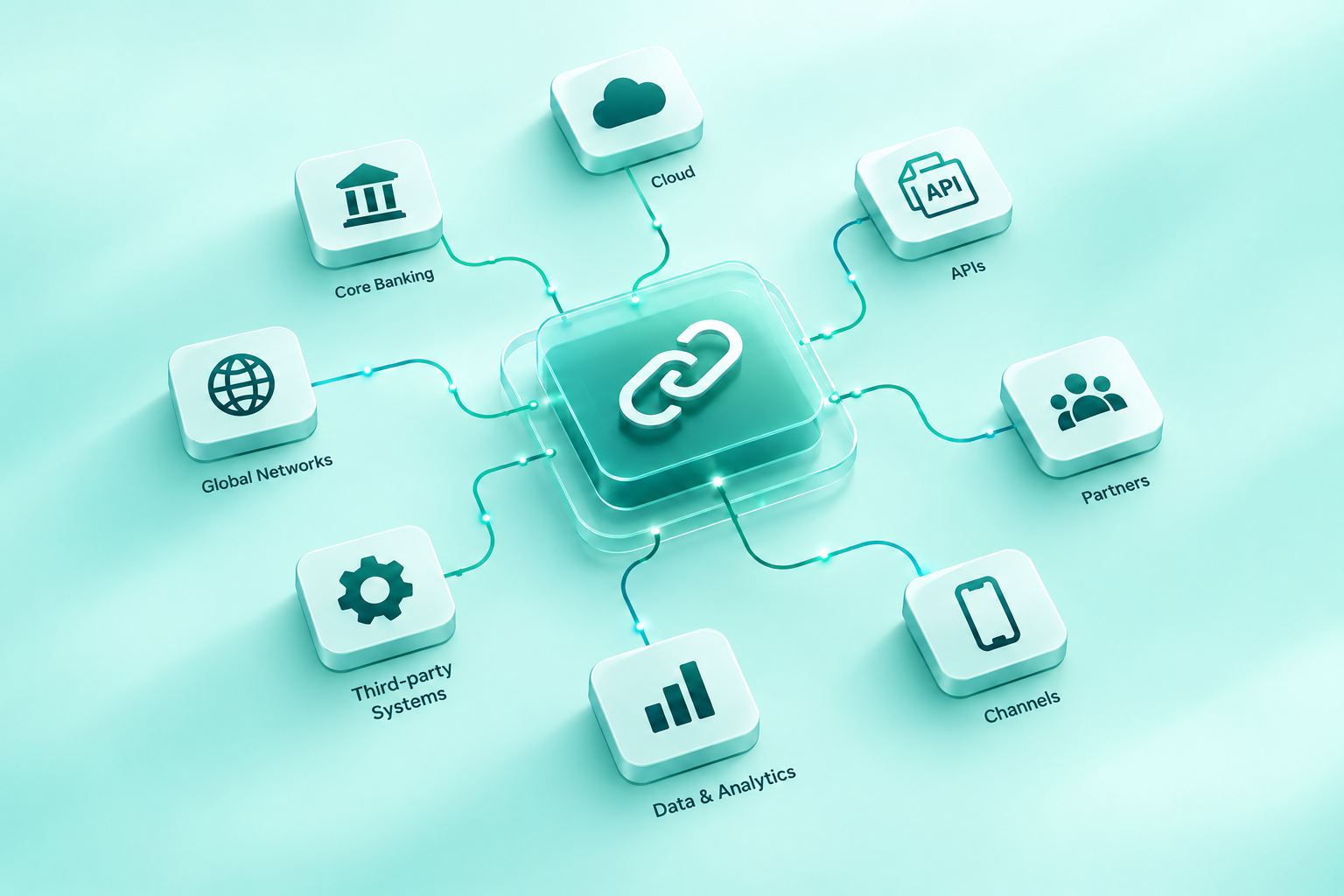
Transaction banking lives or dies on connectivity. It has to reach inward to the bank's core and payment infrastructure, outward to payment rails, SWIFT, trade networks and credit bureaus, and all the way into the corporate's own systems through ERP and host-to-host links and corporate APIs. Few banking domains touch as many systems.
Veefin connects to that estate through VECTOR, its low-code integration and orchestration layer. VECTOR becomes the integration fabric between the bank, its infrastructure and its corporate customers — so the bank integrates once and every transaction-banking capability rides the same connections rather than building its own. VECTOR handles the translation, transformation and routing between the bank's systems and Veefin; new connections are configured, not hand-coded from scratch.
And connectivity here is not just plumbing — it's the moat. Once a corporate's payments, collections and liquidity are wired into its ERP and treasury systems through the bank, the bank becomes part of the customer's operating infrastructure. Every integration completed raises the cost of ever switching away. Connectivity is how the relationship stops being a service the corporate buys and becomes something it runs on.

Veefin holds the #1 position on the IBSi Sales League Table for Wholesale Transaction Banking — recognition earned in the category this page is about, not an adjacent one.

Banks across Asia, Africa and the Middle East run Veefin in production — global and regional commercial banks, development institutions and digital banks, including digital banks that run several Veefin products together on one platform.

The same architecture runs national financing infrastructure at scale — PSB Xchange and Kafalah among it. A transaction-banking stack on Veefin sits on a foundation already proven to run national platforms.
Transaction banking is ultimately a relationship business — between a bank and its corporates, and between a bank and the technology it runs on.
Most banks support that relationship through multiple systems, multiple vendors and multiple operating models. Every capability they add adds complexity: another integration, another security review, another contract, another roadmap to track, another party to hold accountable.
Veefin supports it through one platform. A bank can adopt the whole stack or start with a single capability and extend on the same foundation — and what it extends is not just one architecture, but one relationship: one vendor, one roadmap, one commercial negotiation, one line of accountability. Adding capability stops meaning adding complexity.
That is the difference. Most banks add capabilities by adding complexity. Veefin adds capabilities by extending the same foundation — a stronger transaction-banking business on a simpler institution.
One relationship engine. One platform. One control model. One integration fabric. One commercial relationship.