
Originate, underwrite, disburse, service and collect on one platform. Intelligence improves every decision, while a low-code product factory launches new lending products in weeks, not months.
Lending is a chain of decisions — acquire, underwrite, disburse, service, collect. In most banks, each link runs on a different system, bought at a different time from a different vendor.
So the organisation learns in fragments. Origination learns one thing about a borrower. Servicing learns another. Collections learns a third. None of it returns to the next lending decision — the lessons sit scattered across systems that don't share a record.
This is why adding AI to one stage doesn't fix it. It makes one stage smarter while the organisation stays disconnected. A smarter silo is still a silo.
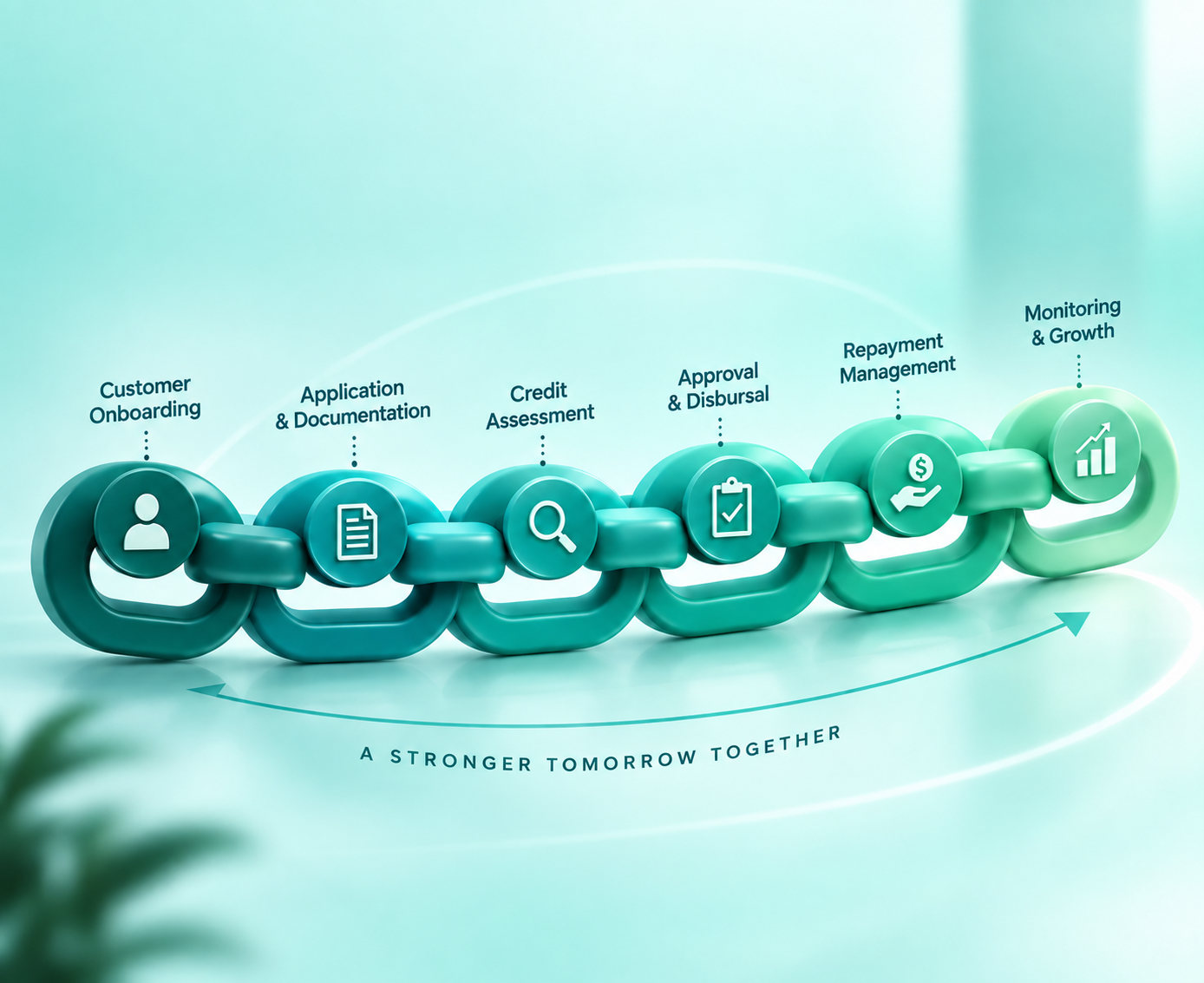
Veefin runs the entire lending lifecycle — origination, servicing and collections — on one platform, against one borrower record. The same data layer, the same governance, the same audit trail, from application through to recovery.
So the credit officer who approved the loan and the collections team working it years later are looking at the same record — not two versions of the same borrower stitched together after the fact. Nothing is lost in the handoff, because there is no handoff.
Most lending stacks are assembled in stages: origination belongs to one system, servicing to another, collections to a third. Every handoff between them loses context. Veefin keeps the borrower on one record from application through recovery — and that changes what the system can do.
Because every stage shares that record, lending stops being a straight line and becomes a loop. Every application sharpens the next credit decision. Every repayment and every default teaches the risk models. Every collections outcome feeds back into how the next borrower is underwritten. Application, decision, performance, insight — and a better decision next time.
Over time, the institution accumulates something more valuable than a portfolio. It accumulates lending intelligence. Every approval, every repayment, every delinquency and every recovery becomes part of the knowledge used to make the next decision. The organisation learns continuously, because the lifecycle is connected.
It is also why intelligence can run across the whole lifecycle rather than in a single stage. A model can only learn from what it can see. Most lending systems can only decide from a fragment of the borrower's story; Veefin can learn from the whole story, because the whole lifecycle lives on one record.
One borrower. One lifecycle. One record. It is the simplest idea on this page, and the hardest to retrofit — and everything else Veefin does in lending is built on it.

Configurable journeys, decisioning and disbursal for any lending product, retail to corporate.

Servicing, schedules, interest, DPD/NPA and accounting on the same record the loan was born on.

Digital, telecalling, field and legal collections, working from the full borrower history.
Veefin covers the whole of lending as one connected flow — not five products a bank has to integrate, but five stages on one platform, one record beneath all of them.
Configurable application and onboarding journeys for any lending product — retail, SME or corporate — driven by a business-rules engine the bank's own team controls: KYC, bureau checks, document and income verification, credit-policy logic and sanction flows, configured rather than coded. One pipeline view across every product the bank runs.

Rules, scorecards and risk-based decisioning apply the same credit policy the same way across every branch and channel — automated where the policy is clear, escalated where judgment is needed — with multi-level approvals, exception handling and a complete audit trail.

Agreement generation and disbursement, straight-through where the rules allow, with the accounting entries raised as it happens.

Post-disbursement servicing on the same record: scheme and repayment setup, interest and charges, days-past-due and NPA management, and a full Customer 360 and Loan 360 view. The loan is serviced from the very record it was originated on.

Campaigns, configurable strategies, restructuring, promise-to-pay tracking, a geotagged field-agent app and integrated dialer — collections working from the same borrower record as origination and servicing, with the full history rather than a fragment.
Because journeys, rules and products are configured rather than engineered, a bank can launch a new lending product — a new SME loan, a secured-lending programme, a digital cash-flow loan — on the same platform without rebuilding anything underneath. This is the other half of the story: intelligence improves the lending you do today; the product factory lets you launch the lending you don't offer yet.
What it earns: faster time-to-yes and time-to-cash on every product, one credit policy applied the same way across the whole book, stress seen early and recovered well — and the reach to launch new lending products without a build. One record from application to recovery is what turns five lending costs into one compounding asset.
One platform. One record. Five stages that behave like one.
Runs on Veefin 4.0 — low-code configuration through VECTOR · common customer, workflow and control model · API-first integration to core banking, ERP and external ecosystems.

Digitising lending made the process faster — applications online, approvals routed, documents uploaded. Intelligent lending changes something deeper: what the people in the process spend their time on.
In most banks, intelligence — where it exists at all — is a feature inside a function. Origination has its tools, credit its models, collections its scorecards; each improves its own corner of the process. Intelligent lending is not a better feature in each corner. It is an operating model: the same intelligence assists every stage, because every stage is on the same record. Intelligence stops being something a lending organisation has, and becomes the way it runs.
So this is what a lending organisation looks like when intelligence runs across every stage — not intelligence trapped inside one part of the lending process, but the routine analysis and preparation that consume credit, risk and collections teams done first by the platform, so those teams spend their time on judgment.
That intelligence shows up in the work at every stage:

Documents classified and read on arrival, financials and bank statements parsed into structured data, identity and KYB verified, fraud signals raised — before a file reaches anyone's desk.
Financial spreading, ratio and trend analysis, scorecards and risk grading, and a first-draft credit memo and recommendation package built from the file — every figure traceable to the document it came from. And every recommendation is explainable: the factors that drove it, what would have to change to alter it, and a complete record of how it was reached.
Early-warning signals on accounts beginning to drift, portfolio and concentration monitoring, covenant tracking, exceptions raised as they arise — so risk is seen early, not at the next review.
Accounts segmented and prioritised by value and likelihood, a next-best-action for each, strategy and timing optimised, restructuring options surfaced — so collections effort goes where it will matter most.
Across all of it, the pattern is the same: intelligence handles the routine analysis and preparation so credit, risk and collections teams can focus on judgment. The work that overloads lending teams today — spreading statements, drafting memos, tracking covenants, prioritising collections — is prepared by the platform and reviewed by the people accountable for it. Every recommendation remains explainable, reviewable and accountable.
Where the bank meets that intelligence is SuperDash — the conversational layer across the platform. A relationship manager, an underwriter and a collections lead each see what their role needs, ask in plain language, and act on the answer. SuperDash is how the intelligence is consumed and acted on; the intelligence itself lives in the work underneath.
And for institutions that cannot move sensitive data beyond their own walls, that intelligence can run inside the bank's own infrastructure, on private and local language models — so a bank can adopt AI without its borrower data ever leaving its control.
None of this replaces the credit officer. The platform does the preparation, surfaces the recommendation and explains its reasoning; the decision, and the accountability for it, stay with the people the institution and its regulators hold responsible. That is the difference between intelligence a lending organisation can actually adopt and intelligence it cannot.
The single borrower record that makes lending intelligent isn't something built for lending — it's how Veefin 4.0 is built. Every Veefin product runs on the same architecture: one data layer, shared services, one governance and security model, and VECTOR, the integration layer that connects lending to the bank's core, its bureaus, its data sources and the channels borrowers arrive through.
So a bank adopting Veefin for lending isn't buying a standalone lending system. It is adopting onto the same foundation that runs the bank's transaction banking and financing infrastructure — proven, governed, and certified to ISO 27001 and SOC 2.
The connected-lifecycle approach isn't a theory. State Bank of India selected Veefin's architecture as the winning design in a competitive lending innovation challenge — a single connected borrower journey from document to credit decision to disbursement, intelligent, explainable and fully audited at every step.
And the lending technology beneath it runs in production with banks, NBFCs and digital lenders across Asia, Africa and the Middle East — the same architecture, the same record, the same governance.
For two decades, lending technology has been about digitising the process — each step faster, each form online, each approval quicker. That work is largely done. The institutions that pull ahead now won't be the ones with the fastest workflows. They'll be the ones whose lending gets smarter with every decision they make.
That is the real distance between digital lending and intelligent lending: not faster processes, but an organisation that learns — and that is only possible when the whole borrower lifecycle lives on one record, because an organisation can only learn from what it can see whole.
Veefin is built for that future. The complete lending lifecycle on one platform. One borrower record, from origination to recovery. Intelligence that learns from every outcome. New products launched in weeks, not months. A lending business that compounds what it learns, instead of scattering it across disconnected systems.
The question was never which lending system to buy. It is what kind of lending organisation you intend to become.