
Onboarding and screening, fraud detection, AML monitoring and credit intelligence — built into every Veefin product, not managed as a separate system beside it. Veefin gives a bank one version of the truth about every customer across onboarding, lending, transaction banking and monitoring. Identity, behaviour, exposure and creditworthiness are computed once and inherited everywhere, so every decision starts from the same picture, not a different one in each system.

Identity, KYC and KYB, screening — at onboarding, and after.

Fraud and financial crime caught as they happen.

From a stack of documents to a scored assessment, before the bank lends.

Early warnings while there's still time to act.
Most banks build their defences one tool at a time: an onboarding system here, a fraud engine there, a separate platform for transaction monitoring, another for credit. Each one works. None of them sees the whole customer.
So the same customer is a different customer to each system. The applicant who clears onboarding on a green light is, months later, the account a monitoring system flags — for behaviour that was there to be seen on day one, in a system that wasn't looking. The borrower approved in lending is already acting, somewhere else in the bank, in a way that would have changed the decision. Each system holds part of the truth. None of them holds all of it.
And risk lives in the gaps between them. A signal the fraud engine sees never reaches the credit officer. An exposure the lending book carries is invisible to compliance. The losses a bank takes and the findings an auditor writes up are rarely about a missing tool — they are about the space between the tools, where no single system was ever looking.
You cannot manage risk you cannot see. And a bank that sees each customer four different ways cannot, in any real sense, see them at all.

The answer to a fragmented view of risk is not another system to reconcile the rest. It is to compute the customer once.
Every Veefin product runs on one architecture, around one customer record. So what the bank knows about a customer — who they are, how they behave, what they owe, what they're worth as a credit — is established once and inherited by every product that needs it. The customer a bank identifies at onboarding is the same customer it understands in lending, monitors in transaction banking and screens in compliance — not rediscovered, and not reassessed from scratch, every time they touch the bank.
A risk rating set in one place is the rating everywhere. An exposure taken on in lending is visible to the team that owns the relationship. A signal raised at onboarding follows the customer into every product they touch. There is one version of the truth about the customer, and the whole bank reads from it.
This is why risk intelligence isn't a Veefin system a bank integrates alongside the others. It is a property of the architecture every Veefin product already runs on — which is the only way one view of risk is ever actually delivered, rather than promised.
One view of risk only matters if it changes what the bank does. Across every Veefin product, that one view does four jobs.
The first question in any relationship is the simplest to ask and the hardest to answer: is this customer who they say they are? Identity and KYC verification, business KYC and beneficial-ownership checks, screening against PEP and sanctions lists, and adverse-media checks establish it at onboarding — and keep establishing it, because who a customer is does not stop mattering the moment the account opens.
Some risk is in the documents; some is in the behaviour. Veefin reads both. Document-tamper detection — down to the font, byte and metadata level — and bank-statement integrity checks catch what has been altered. Device and behaviour monitoring and mule-account tracing catch what is being done. Real-time watchlist and sanctions screening and transaction monitoring catch the patterns that matter — tuned to surface the alerts a team should act on rather than bury them under the ones they shouldn't. Financial crime is caught as it happens, not reconstructed after the money has gone.
Before a bank lends, it has to know what it is taking on. Financial-statement and bank-statement analysis, income reconciled across bureau, GST and tax data, scorecards and probability-of-default grading, and a first-draft credit memo turn a stack of documents into a structured, scored view of the risk — so a credit officer starts from an assessment, not a blank page.
Risk doesn't end at approval — it moves. Early-warning signals and continuous portfolio monitoring track the customer after the decision is made, so a deteriorating position shows up as a signal the bank can still act on, not as a loss it explains afterwards.
Four jobs, one view. Each draws on the same record of the customer — which is why the bank gets one answer, not four.
What it prevents: the losses that live in the gaps — the fraud caught after the money has gone, the exposure discovered at default, the deterioration explained in hindsight. One view, held continuously, is the difference between risk the bank manages and risk it reads about in its own loss report.
Runs on Veefin 4.0 — low-code configuration through VECTOR · common customer, workflow and control model · API-first integration to core banking, ERP and external ecosystems.
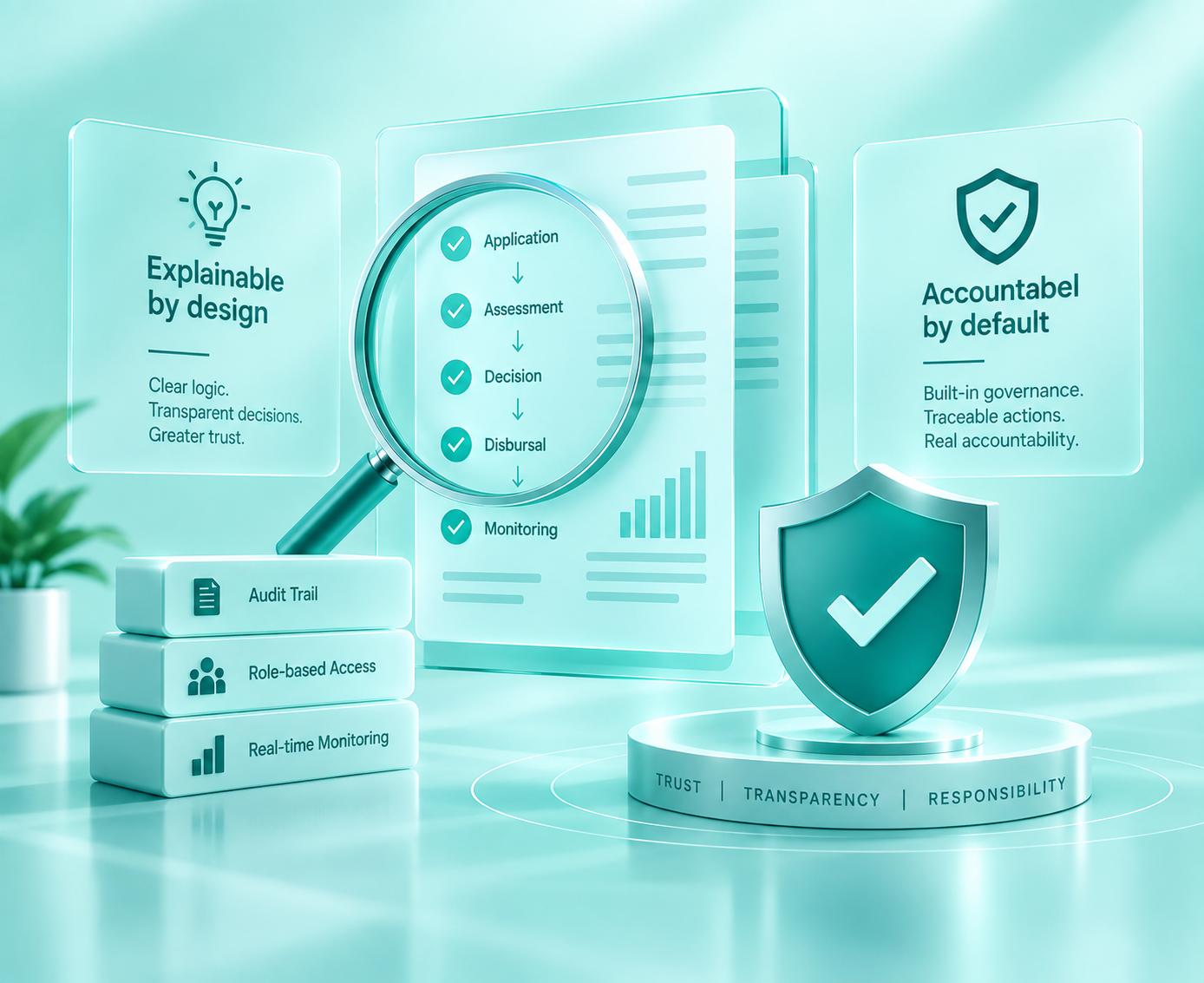
Intelligence is only useful to a bank if a human can defend it. The risk, credit and compliance officers who act on it are the ones who answer to a committee, a board and a regulator — and an answer they cannot explain is worse than no answer at all. So everything Veefin's intelligence produces is built to be questioned.
Every score shows which inputs drove it, and by how much. Every assessment carries a plain-language rationale an officer can read, challenge and sign off on — with a what-if view that shows exactly what would have changed the outcome, so a decision can be explained to a borrower, a committee or a regulator in terms a person understands. And every input, every model version and every output is recorded immutably: the audit trail is regulator-ready on demand, not assembled after the fact when someone asks.
This is also why the intelligence prepares the decision but never makes it. It does the work that slows a decision down — gathering, reading, screening, scoring, drafting — and hands an officer a complete, explainable picture to act on. The judgment stays with the people the bank and its regulator hold responsible, and so does the accountability. For this buyer, that is not a limitation to work around. It is the only version of the technology that is safe to put inside a bank.

The intelligence runs in production today, embedded inside Veefin's lending and transaction-banking products — the same customer record, the same governance, the same audit trail — with banks, NBFCs and digital lenders across Asia, Africa and the Middle East.
The connected approach was also independently validated in a competitive lending innovation challenge conducted by State Bank of India, which selected Veefin's architecture as the winning design — a single underwriting pipeline in which identity, screening, fraud checks and explainable credit intelligence were built into the flow, not bolted on at the end: one record, one explainable decision, audited at every step.
Proven in production, and validated against one of the most demanding standards in the market — the connected view of risk is something a bank can verify, not just something Veefin asserts.
One view of risk is only possible because there is one of everything beneath it. This intelligence is not a system that sits beside Veefin's products; it runs on Veefin 4.0, the architecture every Veefin product runs on — one data layer, one governance and security model certified to ISO 27001 and SOC 2, and VECTOR, the integration layer that connects the credit bureaus, registries, watchlists and tax and GST sources the intelligence draws on.
So a bank does not buy risk intelligence as a separate platform to integrate, secure and govern on its own. It inherits it from the same foundation its other Veefin products already run on — already proven, already governed, already certified.
Every bank already has risk, fraud, compliance and credit tools. Few have a single view that connects them — and that gap, not the absence of any one tool, is where losses and findings come from.
Veefin gives a bank one view: of who a customer is, how they behave, what they're exposed to and what they're worth as a credit — computed once, explainable and accountable, and shared everywhere the bank already runs Veefin. Not a better risk system bolted onto the others. The same intelligence, inside every product — so every decision the bank makes starts from the same truth.