
Meet your AML, KYC and sanctions obligations with fewer false positives and faster onboarding — verification from data, screening built into the flow and continuous after it, and every decision defensible to your regulator. On one customer record, inherited from the platform your products already run on.
Every bank carries the same obligations — KYC, AML, sanctions, ongoing monitoring. Most carry them as pure cost: a queue the customer waits in, a team that grows with every new rule, an audit season braced for annually. But the obligations are symmetric, and the execution is not. The bank that verifies fastest wins the customers that abandon slower banks' queues. The bank that screens cleanest spends its analysts on real risk instead of noise. The bank that can answer its regulator on demand carries its obligations with margin — and margin, in compliance, is a competitive position. The prize runs deeper than efficiency: the institution that holds the most complete picture of its customers makes better decisions everywhere that picture is used. Own the truth about the customer, and growth stops arguing with compliance.
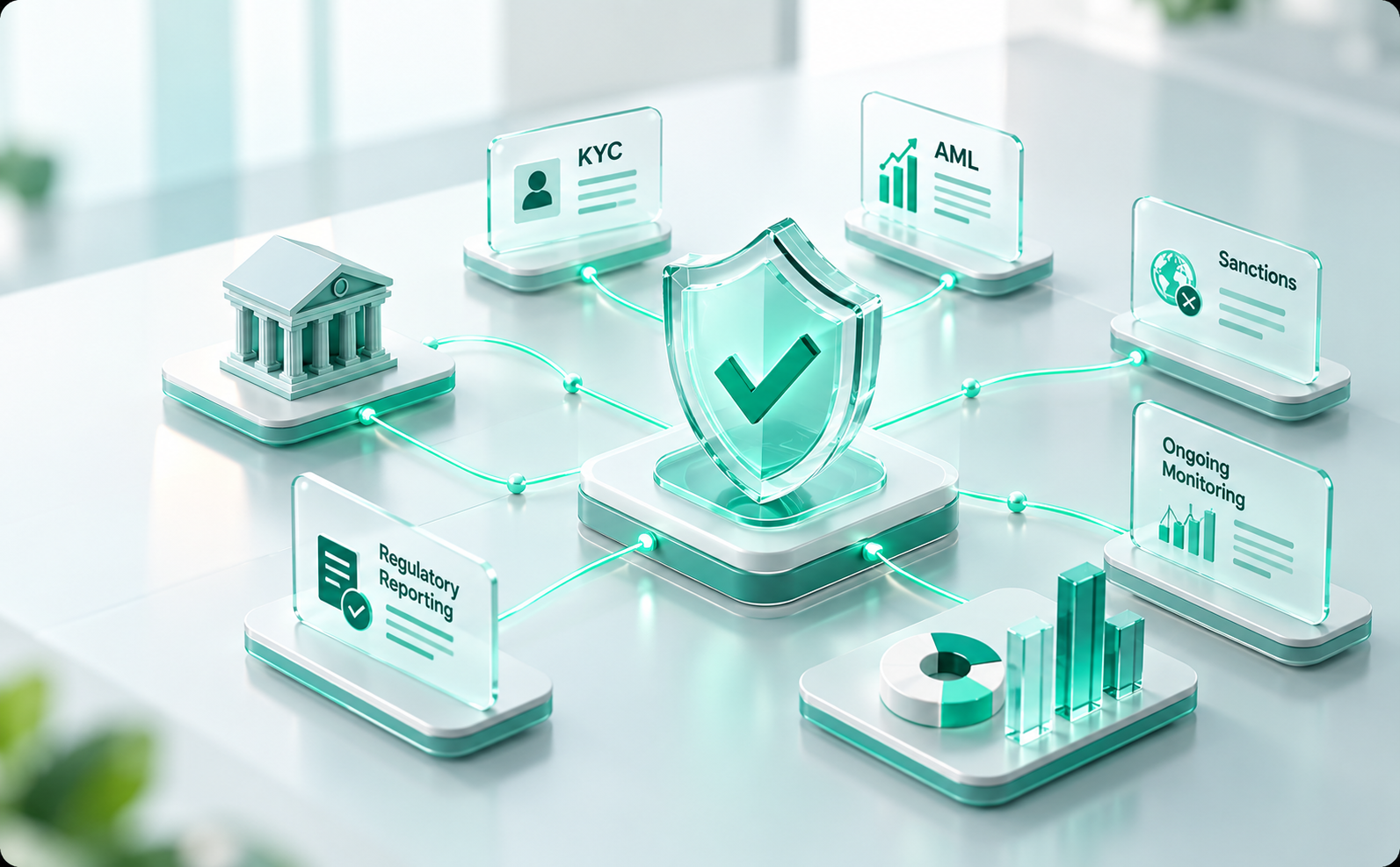

The onboarding most banks run makes the customer do the work — forms, documents, repeat requests, waiting — friction standing in as a proxy for diligence. Confident onboarding inverts it.
In practice: a customer applies, and the bank verifies — identity, business ownership, sanctions and PEP exposure, adverse media — from data, at machine speed, asking the customer only for what verification genuinely needs. Deeper checks than the manual process ran in days, concluded in minutes. Decisions that arrive while the customer is still paying attention. And the screening doesn't end when the account opens: the picture is refreshed continuously, so the file the regulator sees is current, not archaeological.
That is the target state — diligence deep enough to satisfy the strictest reviewer, delivered so fast the customer barely notices it happened. The bank that reaches it stops choosing between its funnel and its obligations, and starts winning customers from banks that still make them queue.
Most screening estates were assembled defensively — a tool per obligation, each tuned never to miss anything, because a vendor's first incentive is never to be blamed. The result is an economy that runs on noise. Alerts multiply; analysts triage; queues lengthen; onboarding slows. Every false positive costs twice: once in the customer it delays, and once in the real alert it buries. The standard response — add analysts — scales the cost without adding safety, because the noise grows faster than any team can. And because KYC runs as an episode rather than a process, the file starts ageing the day it is completed: the customer verified at onboarding is a stranger again within a year, until a remediation project rediscovers them at consulting rates.
None of this is a failure of effort — compliance teams work as hard as any in the bank. It is the economy their tools created, and buying one more defensive tool deepens it. The trade-off between speed and safety that everyone assumes is not a law of compliance. It is the signature of fragmented screening.
The answer to the false-positive economy is not a braver risk appetite. It is screening built differently — into the flow, on one record, tuned for signal.
Built into the flow: verification and screening run inside the onboarding journey, not in a queue behind it — checks conclude while the application is still moving, so diligence adds depth without adding days. On one record: every check runs once and follows the customer — identity verified, ownership mapped, screening outcomes held — inherited by every product they touch rather than repeated by every system that meets them; this is the mechanism the Risk page calls computed once (→ Risk, Fraud, Compliance & Credit Intelligence). Tuned for signal: screening calibrated to surface the alerts a team should act on rather than bury them — analysts spend their day on risk, not on triage. Defensible on demand: every decision explainable, every input and outcome recorded, the audit trail regulator-ready before anyone asks. And continuous: re-screening and monitoring run on after onboarding, so the file stays current instead of ageing toward remediation.
The dividend runs in both directions: confidence is what makes the speed safe — and the speed is what makes the compliance affordable. The bank stops paying twice for noise, and its obligations start paying the bank back.
One outcome, five ingredients — each carrying its part of the truth:

The front door: applications that move at the customer's pace, with the checks inside them.

Who the customer is, and who stands behind them, established from data.

Who the bank must not bank — caught at the gate, and after it.

Behaviour watched where it happens, tuned for signal.

The file kept current, the picture kept honest.
Individually, each is a control. Together — on one customer record, under one governance model — they are the confidence this page is named for.
The screening and monitoring on this page are not a roadmap. They run in production today, embedded inside the lending and transactionbanking products Veefin's clients already operate — banks, NBFCs and digital lenders across Asia, Africa and the Middle East — on the same customer record and under the same governance this page describes. The full evidence, including how the connected design was independently validated, lives with the capability itself.
Every bank runs the same gauntlet: grow without slipping, screen without stalling, satisfy a regulator whose questions get harder every year. Most run it with tools that force a choice — speed or safety, funnel or file. The choice was never real; it is simply what fragmented screening feels like from the inside. Verify from data, screen on one record, tune for signal, keep the file current — and the same system that satisfies the strictest reviewer is the one that wins the customer while competitors are still asking for documents. The bank that owns the truth about its customers stops paying twice for noise — and starts getting paid back in growth.